Shilling for Shilling Ales: A Brief History of Scottish Brewing
For many years, there was a lot of misinformation out there about Scottish beers - there would be romanticized visions of deep, caramel-rich, peat-smoked Scotch ales. Sometimes they’ll reference the “Shilling” names as a relic of an old tax system. Unfortunately, sometimes even some of the standard bearers get their wires crossed. With all due respect to Odell, this summary on the page for their flagship 90 Shilling Ale is just a little bit outside:
The name 90 Shilling comes from the Scottish method of taxing beer. Only the highest quality beers were taxed 90 Shillings.
Of course, the real story is that the shilling designations described their wholesale price per Hogshead, not their tax rate. And the really interesting part they leave out entirely is: 90/- Pale Ale was actually a premium bottled pale ale from William Younger in the 1940s. [1]
Pre-Industrial Scottish Brewing
Before the Industrial Revolution, and before the United Kingdom itself, Scottish brewing looked different, but still fit within the broader brewing traditions of the British Isles. The monks of Holyrood Abbey in Edinburgh are thought to have been brewing since the 1200s and were known internationally for their “nut brown ale” by the 1500s. Isn’t it funny how often it starts with monks? [2 p.8-9]
Pre-industrial Scottish beer used darker, amber to brown malts, kiln dried with peat, straw, or pit coal. [3 p.103] Wood was not a reliable fuel because Scotland was severely deforested by the 1500s. A source from around 1680 mentions at that time that peat was preferred because it would burn predictably and evenly, but would leave a “peat reek” that would have to age out, like how the acrid smokiness had to age out of Porter. [4 p18 ]
So there you have it: the idea of Scotch ales kilned with peat does have precedent, but it is heavily romanticized, as they stopped using it as soon as coke became the preferred fuel. Additionally many Scottish breweries were also concentrated in the area where coal was most available as a fuel. [5 p.16]
Scottish brewers used “bigg” - a hardy, six row barley variety of an inferior quality [2 p.6], and also commonly used oats in their beers, something that would be revived for Oatmeal / Oat Malt Stouts around the turn of the 20th century in spirit. Oats were a critical crop because they grew well in the hardy environment. [2 p.9]
Before hops were in common use, heather flowers were a common substitute in Scotch ales [2 p.8], along with other bittering agents:
Before hops dominated, brewers turned to a wide pharmacopeia of local plants, including ginger, horehound, yarrow, ground ivy, and wormwood, to bitter and flavor their ales. [2 p.72]
While hops are in fact not native to Scotland, their use by Scottish brewers requires the broader context of British brewing as a whole: first, the British weren’t using hops until the 1500s when hop cultivation was introduced by Flemish immigrants who were converted to using hops by beers from Northern Germany, and resisted it up until an act of Parliament in 1710 banned hop substitutes. [6] Second, hops can grow in Scotland, but perhaps not very well, and never have been grown in any appreciable quantity. Third, that didn’t stop them from importing absolute loads of hops, as we will find out later, with the United States as a major source. [5 p.17]
Effectively, substitute grains aside from barley were gone from Scottish brewing as a result of British tax laws, and hop substitutes from more of the same, under the ever creeping auspices of watching out for the public health.
How England Nearly Dissolved the UK by Ruining the National Drink of Scotland
While the Scots were known for their strong ale, the commoners drank a commonly available cheap beer called “twopenny” or “tippenny” - called such because it was available for 2 pence per Scots pint, equivalent to about 1.7 Liters. While the strong ale was known for its high quality, around 1600 the weaker beer was not so much:
Scots ale was notoriously poor in both flavour and general quality. Hops were little used, being an expensive, luxury import from England or the Continent. Few contemporary observers had much good to say of the Scots pint: Fynes Moryson wrote in 1598 that the ale drunk by the ‘the better sort of citizens’ was so bad that it would ‘distemper a stranger’s body.’ If this sort of comment was typical, it is perhaps not surprising that the Scottish parliament was worried. Some evidence indicates that the growing challenge to the Scottish domestic product from imported ale was growing throughout the century.
[3 p.3 ]
In 1707, Scotland and England joined under a single Parliament under the Treaty of Union, after having been unified under a single monarch for 100 years. Twopenny was so important it was given a special provision in the acts, so that the Scottish malt would not be taxed during the ongoing War of the Spanish Succession, and it could remain at that price. They still had to pay tax on the finished beer, but it wasn’t like in England where the taxman double dipped, taxing the malt and the finished beer. This was in place because at the time Scotland was economically depressed. [3 p.10 ]
This triumph would be short lived, as the British government attempted to raise a tax on Scottish malt in 1713 after the Treaty of Utrecht ended the War. While this was technically within the rights of the Treaty of Union, the Scots thought it was so unfair, it almost led to the dissolution of the United Kingdom: which came within four votes in the House of Lords. This led the government to back off enforcement of the malt tax… until 1725… [3 p.10-11]
Once the malt tax was in place, it conflicted with the provisions that kept twopenny at its nominative price, wiping out any profits that could be made from it. Inevitably, brewers had to make it much weaker, from later runnings. Ron Pattinson estimates original Scottish twopenny had an OG around 1.045. [4 p.288] David Booth laments the post unification decline in The Art of Brewing (1829):
At and previous to the beginning of the eighteenth century, every publican in Scotland (being every man who chose to embark in the trade) brewed his own ale; and the resort to his house depended on the quality of his liquor; which, when thunder or witchcraft did not interfere, was generally excellent. The strong ale was reserved for holidays and the tables of the great; but the twopenny (so called because it was sold at twopence the Scotch pint) was so much esteemed as a national beverage, that it was inserted by name, and guarded by peculiar privileges, in one of the Articles of the Union. Another Article, however, in the same Act, secured to the Scottish brewery an Exchequer Court; and this, conjoined with the enormously increased malt duties, so lessened the exhilarating qualities of this ancient ale, that it has now lost its fame. In its stead, a kind of small drink is brewed; but it is destitute of all the qualities which were so often celebrated in Scottish song, and is scarcely superior to the trash termed table-beer in the workhouses of the metropolis. [4 p.38]
Around the same time, the market had to deal with the nascent influx of cheaper, tax dodging whisky from the highlands. Reportedly, when the King came to visit, he preferred the illicit stuff, as the legit producers were skirting the tax by using unmalted adjuncts. But that’s a story for another blog…
From Industrialization to New Markets
The mid 18th century would bring with it the beginnings of the Scottish Industrial Revolution, and along with it, several important brewers, including Drybrough & Co. William Younger claims its founding date as 1749, but it turns out that’s something of a marketing myth: William Younger was 16 years old at that time, and only entered the brewery business at all later in life, which was mostly carried out by his family after his death. The 1749 date comes from the James Blair’s Abbey Brewhouse, which was acquired by Younger in 1803. [7]
The union with England brought with it the opportunity for Scottish brewers to expand into new markets, and for beer to be shipped from other markets as well. From 1780-1820, exports of Scotch ale became increasingly popular, and commanded a high price. William Younger was exporting their “Edinburgh Ale” to England by 1810. [3 p.113]
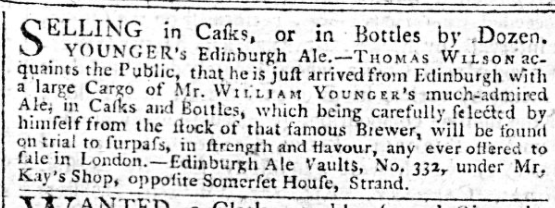
Ad for William Younger Edinburgh Ale in Casks or Bottles. London Morning Herald. Published April 21, 1802
It appears the genesis of the “shilling system” came along with the industrialization of brewing in Scotland: before the 1750s most of the brewing was done at home or by pub owners. Between 1780 and 1820 the number of commercial public breweries rose from less than 50 to 240. [2 p.11] By the 1790s, the shilling designations were being used in ledgers, and certainly by the 1840s the classic meaning of the system had coalesced.
Beer historian Ronald Pattinson reports that beers in England once also followed this sort of system, before they changed to the system of marking their ales with X’s and K’s. [8 p.89] To support this, I managed to find an advertisement in an 1836 London newspaper for Edinburgh Ale in Shillings per Barrel (36 gal), rather than Hogshead (54 gal):

Ad in the London Morning Advertiser advertising Edinburgh Ale in Shillings, per Barrel, rather than the Scottish standard per Hogshead. Published July 1, 1836.
Pales in Comparison
It is worth noting that Edinburgh Ale / Scotch Ale fits within the broader tradition of strong British Isles ales by resembling Burton Ale, and often directly competing with it. The wikipedia page for Scotch Ale immediately claims it’s the Scottish version of Burton Ale, and the BJCP guidelines for Wee Heavy note the similarities as well. [9]
However, I must point out that the blurb about the hop rate of Burton being twice that of Scotch ale is more of a modern phenomenon. Stock ales had variable hopping depending on the season, and contemporary sources show only a slight difference in the baseline hop rate between the two. A difference in the hop rate otherwise could be explained by comparing a domestic Scotch Ale to an export Burton, for example.
Burton:
The quantity of hops must be three-quarters of a pound per bushel of malt, or more, according to circumstances; but the more that are used, though an advantages a preservative, the higher will be the colour of the ale. [10 p.44]
Scotch Ale:
With regard to the quantity of hops which the brewers in Scotland use for each quarter of malt,it is impossible to fix any certain data, as it varies from four to eight pounds, according to the quality of the ale, and the season of the year. In winter-brewings, six pounds of hops for the best ale, and four for the inferior kinds, may be considered a fair estimate.
Our practice in brewing, from January to March, was, to allow ten pounds of hops per quarter of malt, when the wort was from 95 to 100 of specific gravity … [3 p.89-90]
The author goes on to explain the hop schedule and that the examples specifically are for high gravity, high priced, first wort ales. For the Burton example, 3/4 lb / bushel works out to 6 lbs/quarter, where a quarter of malt is an old unit of weight equalling 336 pounds. The origin of this unit is a rabbit hole in itself, but apparently it derives from the weight of the volume of malted barley that fits in a quarter of a “tun”, which was essentially a giant Medieval barrel. Since malted barley is lighter than raw barley, a quarter of the latter is 448 lbs.
Both started out as strong brown ales, and then would transform into pale, very hoppy strong ales by the mid 19th century as technology progressed, and brewers discovered that pale malt was much more efficient at yielding extract than brown malt, despite the former’s higher price tag. Today, however, the name Burton Ale probably doesn’t have much cachet outside of a few particularly nerdy circles on this side of the pond, we might call such a beer a seasonal “Winter Warmer” today, or the strongest ones a Barleywine, a completely overloaded term that’s referred to any number of very strong beers.
This flies in the face of one of the most persistent myths about the style: that they purposefully boiled first runnings into a concentrated syrup to get deeper flavors and make it darker. The fatal flaw in this claim is that Scottish brewers invented modern sparging, to require less boiling and keep the color paler, which spread to English breweries by the 1850s. [11 p.81]
This was because pale, clear beers were seen as the fanciest beers in this time period, creating an arms race of sorts that led to the mass market light lagers of the 20th century - so that’s what people aspired to brew, especially as the popularity of a beer called “East India Ale” or eventually “India Pale Ale” started to take off and be brewed by Burton brewers in 1820. By the 20th century you begin to see longer boils again. Much like India Pale Ale, and even Berliner Weisse, they were seen as an alternative to white wines after their long Brettanomyces secondary fermentation. Edinburgh Ale was famously pale, as described in The Art of Brewing by David Booth*:*
The distinguishing characteristics of Scotch ale, are paleness of colour, and mildness of flavour. The taste of the hop never predominates, neither in its stead do we discover that of any other ingredient. It is perhaps more near to the French pale wines, than any of the other ales that are brewed in this country. Like them, too, it is the result of a lengthened fermentation. The low heat at which the tun is pitched confines the brewing of Scotch ale to the colder part of the year. [4 p.34]
And one direct piece of evidence exists in the form of the earliest known photograph of people drinking beer: a calotype of people from 1844 drinking Edinburgh ale shows them drinking an obviously fairly pale, fairly clear beer out of something resembling a footed pilsner glass. I would guess the beer was no darker than about 13 SRM, which seems in line with contemporaneous descriptions.

A calotype of people posing drinking Edinburgh Ale from 1844 [12]
From Scotch Ale to Pale Ales
In the mid 19th century, industrial Scottish brewers were brewing a staggering number of products, often just with a crapload of pale malt, a crapload of hops, and whatever moxey and marketing required to market that many products out of it…
The lowest tier of the shilling system was the 40/- Table Beer, and the highest usually was 160/-. Ronald Pattinson suggests essentially that 100/- was the cutoff between “mild” and “stock” ales, which seems to line up by looking at examples from the 1840's. [13] This is generally the case, but there are some exceptions. The beers within the shilling system were meant for domestic Scottish consumption, and were purchased by pubs or grocers to bottle and then sell. Bottling would become more widespread after the abolition of a deeply unpopular glass tax in the 1840s, and even more importantly technological innovations to manufacture bottles, and then fill them more easily in the following decades. [3 p.154] Strong ale, mild ale, and IPA were the styles bottled most often, but sometimes table beers would be too. [14]
While bottling in general was not widespread until around WW1, Leith had a bustling industry for manufacturing glass bottles and the Edinburgh and Leith Glassworks Company were producing around a million bottles per week in 1750, which is quite a bit more than I ever expected before looking into this. Ronald Pattinson points out the emphasis Scottish brewing had on bottling much earlier than in England:
Excuse me if I've said this before. It's so unusual that I want to be sure you know about it. In England the vast majority of beer, even stuff 10% ABV and more, was usually sold on draught in the 19th century. Bottled beer only really started to get any sort of popularity in the last couple of decades of the century. In Scotland, the situation was completely different. In the 18th and early 19th century almost all beer was sold bottled. Brewers delivered hogsheads to shopkeepers and publicans who then bottled it. [13]
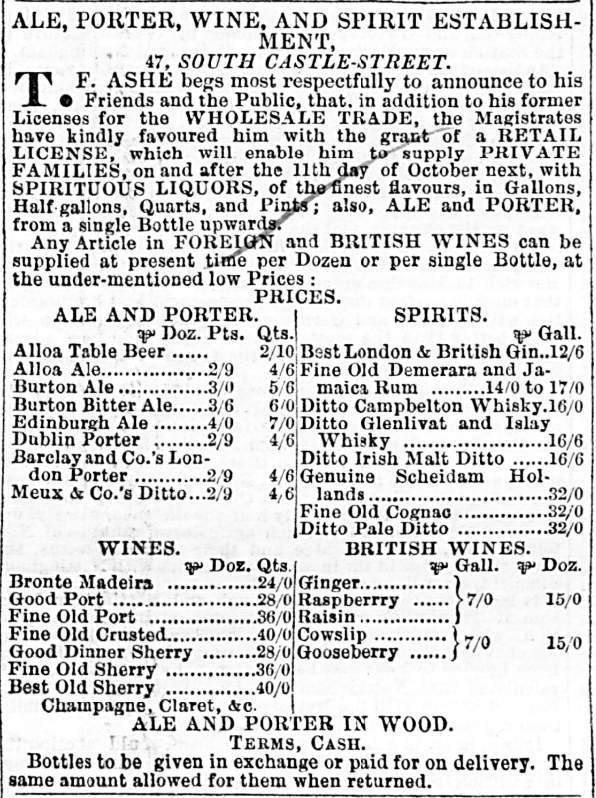
Ad including Alloa Ale and Table Beer, Edinburgh Ale, among other offerings. Liverpool Alblon. Published Monday, September 29, 1845
The Beer House Act of 1830 made it exceedingly easy in England to open a pub that served only beer, a measure designed to combat gin drinking and reduce public drunkenness, which was on the rise after the reduction of duty and rise of often unlicensed “gin palaces”. [15] The Scots, however, wanted to retain more control over their liquor licensing. Special grocers would offer different beers you could take home in a growler, and would have special bottled stock ales available they would bottle themselves off of the cask they purchased wholesale. Patrons could gather and have one of these strong ales with some bread and cheese, creating a sort of licensing loophole and a natural gathering place. [3 p.208]
This ad informs of such a grocer’s impending move, and talks of his stock of “best London Porter, Dundee and Edinburgh Ale, in Hogsheads and Bottles : also Stone Ware and Glass”.
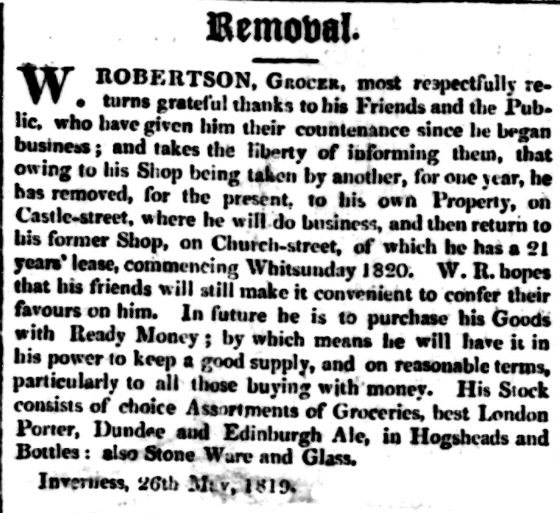
Inverness Journal and Northern Advertiser. Published Friday, May 28, 1819
The classic rich Scotch ales and their lower gravity counterparts were not the only beers sold in the shilling system, as it simply was a wholesale pricing structure. Scottish brewers kept up with the times, and when Porter swept the British empire in the 1700s, Scottish brewers had to follow suit with their own Porters. By the 1840s, the Scots were getting in on the burgeoning IPA market. There were 54/- Stouts, 60/- Pale Ales, &c. By the 1850s, William Younger was brewing Pale Ale for export.[16]
India Pale Ales would become another important market for Scottish brewers. At first these would be stock ales bound for export, but beginning in the 1850s, the domestic popularity of IPA drove a market for domestic, running pale ales, which would also be sold under shilling nomenclature. The market shifted and by the turn of the 20th century was overwhelmingly in favor of running beers, and in particular, pale ales. By this time, hops were imported from the United States as well as the continent, and they frequently begin showing up in the logs after that. [5 p.17]
As Burton Ale and Scotch Ale were in direct competition, William Younger in the 1860s created a new series of products numbers 1 through 4, meant to be premium export products to compete directly with the similarly numbered ales of Burton brewers. As running beers became increasingly preferable to the public, Younger dropped No 2 and No 4, and No 3 transformed into a sort of “pub ale” of modest gravity, especially as the hop rates dropped further post World War 2. [17]
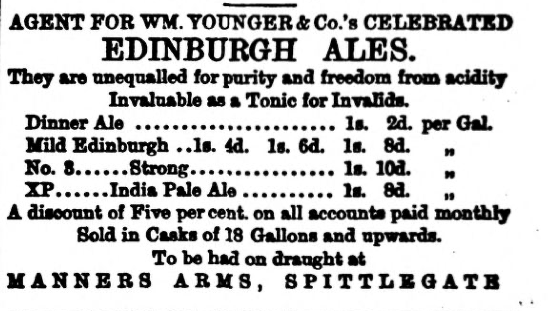
Ad for William Younger Edinburgh Ales, showing Dinner Ale, “Mild Edinburgh”, & No 3 Strong Ale! Grantham Journal. Published Saturday, October 30, 1880
Breweries would follow England’s lead and have parallel offerings with the X system, which would go into barrels or half barrels to serve on draft rather than into hogsheads for bottling. It is worth noting these “milds” up to XXX still could be in the 1.090 range, and estimated in the ~100 IBU range. Scottish brewers products of a wider gravity range than English brewers did. Then above that, they would offer S, XS, XXS, and XXXS stock ales with higher hop rates designed for aging. [5 p.41]
Perhaps an example of William Younger’s beers in 1868 with roughly equivalent products will help illustrate:
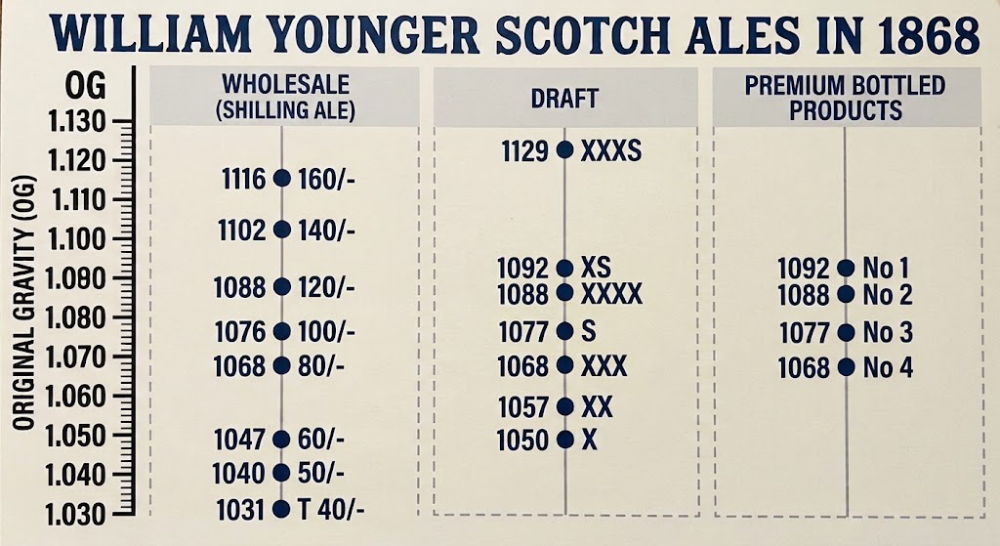
Data Source: http://barclayperkins.blogspot...
You might notice some oddities, namely that there is no XXS and instead XXXX exists as a stock ale in its slot, such a designation seems to have been popular for “old ale”. Also, these clearly were separate brews, as they had different gravities and the stock ales had much higher hop rates. As draft pale ale had become popular by this time, beers coded XP and XXP also show up on the list.
Beer prices stayed remarkably stable during the Victorian Era, and the shilling system’s wholesale price structure stayed fairly stable for a while as well. During the 1860s, Scotland had 119 pubs that still brewed their own beer, whereas England still had around 20,000, illustrating how Scotland seemed to jump straight to mass industrial brewing compared to England. [18]
Prime Minister Gladstone… Let My Mash Tun Go!
Now, with every product comprised of pale malts, how did they differentiate products? On top of differences in brewing process and handling, many sources refer to the use of “Scotch malt” or “high dried” malt in the grist of Scotch ales in the 19th and early 20th centuries. A source from 1907 implies through their respective diastatic power that “high dried” malt was darker than mild malt, and was made with inferior quality barley. [19] This would have given the beer more richness, biscuit character, and made the resulting wort with more dextrins, and would be used in different proportions by breweries to add complexity to milds, and more “keeping power” for stock ales. What really doesn’t help is that “high dried” seems to be an overloaded term, just meaning that it isn’t “low dried” pale malt, so it’s super difficult to pin down. Breweries used to do their own malting, so its possible this sort of information gets lost in the ledgers sometimes. It seems, as malt making itself became more industrialized, “mild malt” became a more defined product. Ron Pattinson suggests Munich malt, or Simpsons Imperial Malt (which is difficult to find in the States) as substitutes. [20]
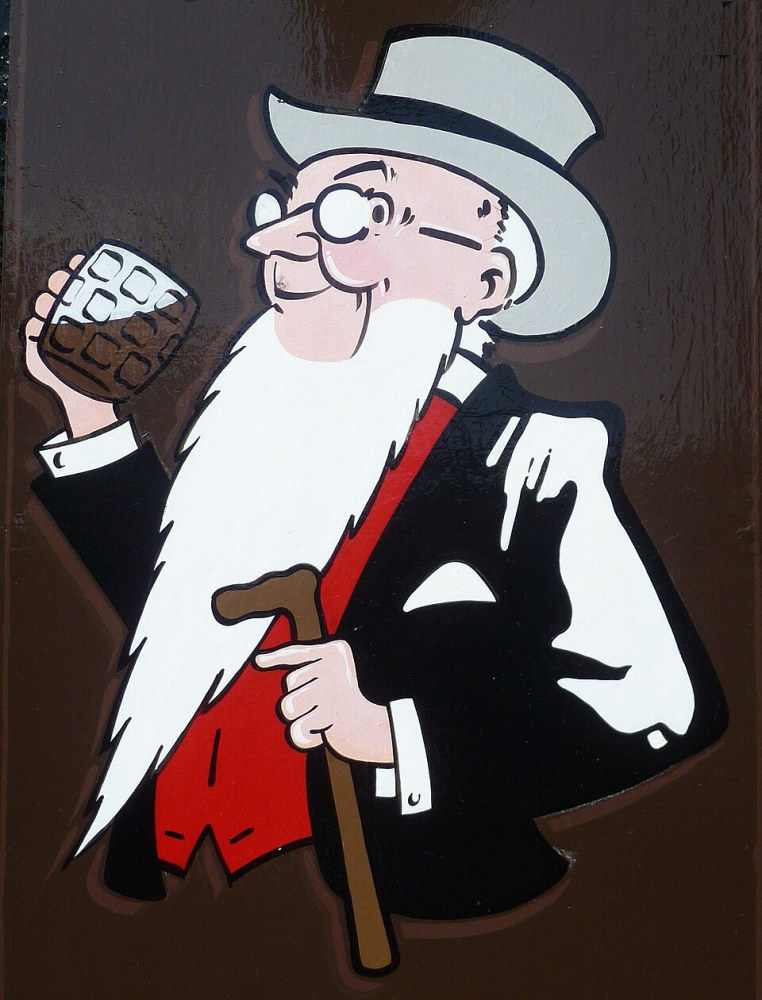
Sugar had been legal to use since 1847, but Scottish brewers were slow to adopt it until the Inland Revenue Act of 1880, aka The Free Mash Tun Act. Before 1880, it was still somewhat prohibitively expensive as the tax man wanted to make the same amount on sugar as malt, until the price of malt went up. After 1880, you start to see more sugars in the recipes. Scottish brewers resisted grain adjuncts a little longer than the English. But once they embraced adjuncts, some of them really went for it. Looking at you, Father William!
While the English preferred flaked rice at first, then flaked maize, corn grits were the adjunct of choice for Scottish brewers. They installed cereal cookers to use them, and no one was crazier about grits than William Younger. [5 p.77] Their flagship No 1 strong ale used a staggering 40% corn grits in 1913. Modern brewers balk at the idea of strong Scotch Ale or Barleywine having corn in it, but some of them had huge amounts of corn and invert sugar syrups, and likely would have been quite dry after a long Brettanomyces secondary fermentation did its thing in the wooden vessel. There were barleywines like this in the 1950s as well, and they became a trend when many had become darker by then, and after post war austerity allowed the brewing of luxury strong ales again.
There is sometimes a misconception that these were some some sort of substitution in times of duress, but it was the other way around - they preferred to use corn until wartime restrictions prevented it. In the early 20th century, the grain for British beer typically came from all over the world, and maize was imported from the United States. Ron Pattinson notes the source of Thomas Usher’s barley in 1912:
A glance at Thomas Usher’s brewing records from 1912 shows how diverse the origin of their barley was. There’s malt described as Hungarian, Danish, Calcutta, Smyrna (Turkey), Ouchak (also Turkey), Polish, Karachi, Danubian, Roumanian, Tunis, Californian, Oregon, Bulgarian, Spanish, Canadian and finally, three pages in, the first mention of Scotch . (Remember that this is the source of the barley, not where the malt was made. The malting would have been performed mostly in Scotland, perhaps some in England.) Malt from locally-grown barley was always less than 50% of the grist. [5 p.76]
Many British brewers of the era also used 15-20% American 6 row malt in their grist, usually malted in Britain, to aid in filtration as well as help convert the adjuncts, which kept the body light, and the simple grist as a whole was designed to optimize extract at scale. [5 p.152]
The Shilling System Breaks Down
After the Free Mash Tun Act, the changing tax structure, and changing tastes, the original meaning of the shilling system started to break down. At first there were some outliers, like Thomas Usher’s 68/- M, a 1.080 beer that was much stronger than their 80/-, superficially a contradiction. I think such variances could be internal system codes for production, specifically this beer superficially looks a bit like a competitor to a draft Burton ale, something that would be a British pub staple by WW1.
Leading up to WW1, the classic indigenous “Shilling Ales” had been very slowly dying off for a long time. Ron Pattinson also notes that they seem to have been either replaced by, or transformed into English-style Mild Ales and Burton-style Strong Ales before mostly dying off after WW1. [8 p.90]
Speaking of World War 1, it was the death knell for the old Shilling system as well as the indigenous Scottish ales. Due to wartime government restrictions on gravity and price controls, the names and prices decoupled entirely from reality, the modern “strength bands” of 60 (Light), 70 (Heavy), and 80/- (Export) took hold, now usually referring to a series of pale ales. Some breweries, such as Maclay in the 1930s decided to call them IPAs despite ranging from 1032 to 1045 in original gravity. Maclay went from in 1909 offering two stouts, two milds, four pale ales under shilling designations, and a strong ale. By 1938 it was three “IPAs” and a strong ale.
Another quirk of Scottish brewing in the 20th century was the extensive use of caramel coloring after racking to make a beer the desired color for different products or different markets. Brewers would use caramel coloring to make one product into multiple, for example, coloring a 60/- darker in order for it to take the place of a Dark Mild at a bar. [21]
In the inter war period, hop rates were cut in Scottish beer, leaving it a little sweeter in the balance than its English counterparts. Thus, the modern Scottish beer styles were born, and after WW2 coalesced into their modern forms, adopting more crystal malts, like English bitters at the time. Just in time for William Younger & Co to celebrate their dubious bicentennial:
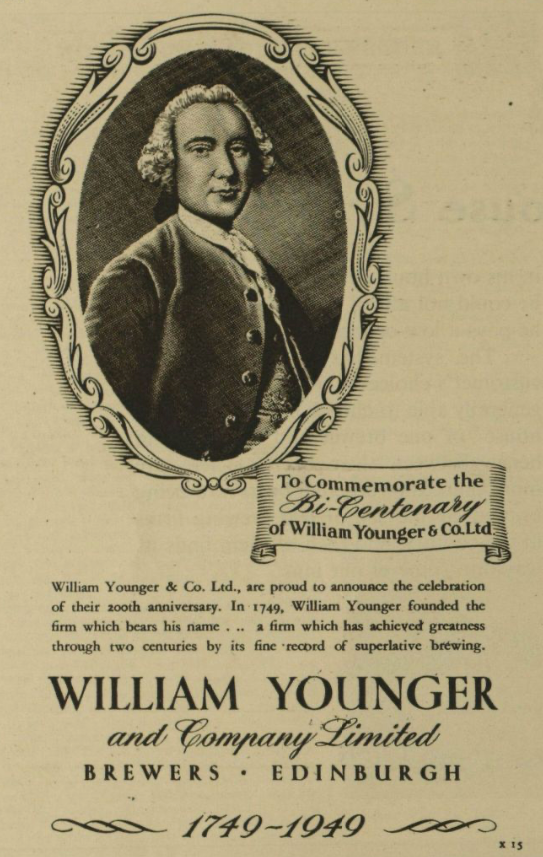
The Illustrated London News. Published Saturday, April 23, 1949
By the 1950s also, the term “Wee Heavy” had become more officially codified as a term for strong Scotch ale - colloquially in the inter war period it had been known as such because in those days brewers started packaging them in small, half-sized “nip” bottles. Fowler’s Twelve Guinea Ale started printing that it was their “Wee Heavy” and then eventually switched to that name. Belhaven, on the other hand, uses the name despite the beer coming in a standard bottle. Oops! [22] I think the BJCP Guidelines had it more correct when the style was called Strong Scotch Ale, but the old guidelines also contain every myth about the style we’ve busted in this article today.
Conclusion
Scottish beer styles are a snapshot in time of a subculture of the broader brush that is brewing on the British Isles, built on the relative nomenclature of an old wholesale system, and a currency that is no longer in use.
In short, 60, 70, and 80 shilling are Pale Ales, with a slightly sweeter balance, and sometimes colored to look a little dark and do a passing impression of a mild. And as the BJCP guidelines for Wee Heavy conveys, it descends a little more directly from the Edinburgh Ales of yore.
In the modern day, 90/- sometimes is reserved for some sort of premium product: Belhaven advertises their Wee Heavy as 90/- on the bottle. Still, the shilling designations could be all over the place relative to gravity post WWII, William Younger offered an 80/- at 16d and a 105/-as 15d in the 1940s.[1]
Scotch Ale / Wee Heavy, as it is the Scottish version of Burton, is therefore the Scottish version of barleywine, and some even have been given that name in marketing. Don’t believe me? That’s okay, here’s an advertisement from the 20th Century for William Younger No 1 Scotch Ale from the 1950's!:
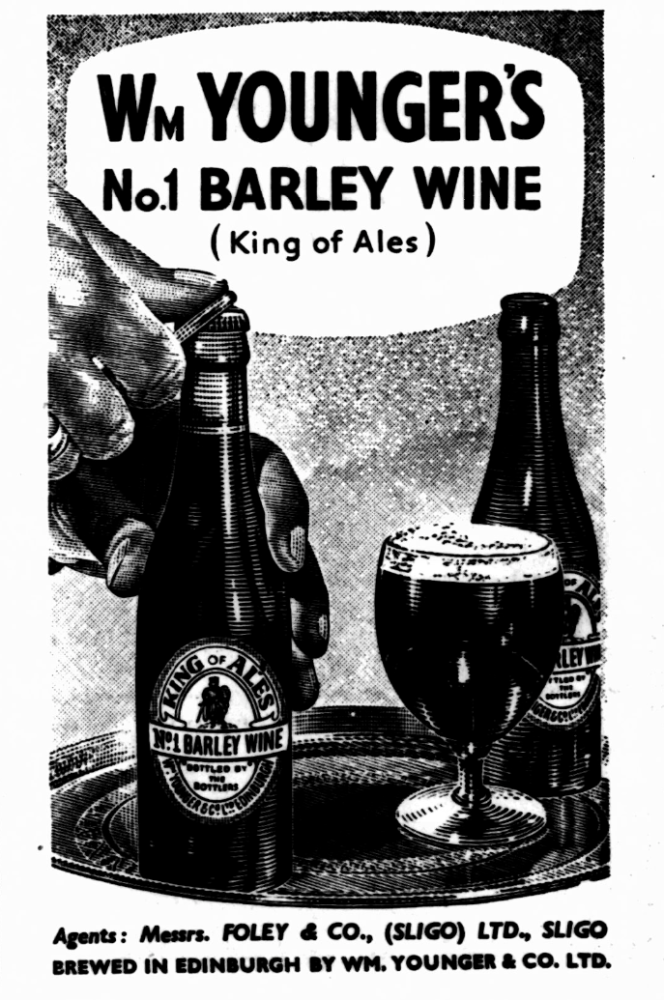
Ad for William Younger No 1, now called a Barley Wine here!
Sligo Champion. Published Saturday 4 July 1953
So finally, the system settled into its modern form: relative strength bands stood in as the ghost of a prior era, like the wisp of smoke from black malt or roasted barley that adjusts the color, and reminds poetic writers of the peat smoked times of yore, when there was only twopenny and Scotch Ale... And the peat… Ahh, the peat… Let’s leave that to the Scotch Whisky producers.
References
[1] Pattinson, Ronald. Shut Up About Barclay Perkins! - William Younger's Pale Ales 1946-1959
[2] Noonan, Greg. Scotch Ale
[3] Donnachie, Ian. A History of the Brewing Industry in Scotland. 2nd Edition
[4] Pattinson, Ronald. Scotland! Volume 1
[5] Pattinson, Ronald. Scotland! Volume 2
[6] Cornell, Martyn. Zythophile - A Brief History of Hops
[7] Records of William Younger & Co Ltd, brewers, Edinburgh, Scotland
[8] Pattinson, Ronald & England, Kristen. 1909 Beer Style Guide
[9] BJCP Guidelines 2021: Wee Heavy
[10] Booth, David. The Art of Brewing (1829)
[11] Roberts, William Henry. The Scottish Ale Brewer and Practical Maltster (1847)
[12] Threadinburgh - Youngers and McEwans in Wonderland: the thread about Scotland’s dominant brewing dynasty
[13] Pattinson, Ronald. Shut Up About Barclay Perkins! - Let's Brew Wednesday - 1868 William Younger 120/-
[14] Pattinson, Ronald. Shut Up About Barclay Perkins! - Bottled Beer in the 1840's
[15] Almwch History: Beer Houses
[16] Pattinson, Ronald. Shut Up About Barclay Perkins! - England vs Scotland, part 3f: early 1850's Pale Ale
[17] Pattinson, Ronald. Shut Up About Barclay Perkins! - Let's Brew - 1933 William Younger No 3
[18] Pattinson, Ronald. Shut Up About Barclay Perkins! - The Scottish Brewing Industry in the 1860's
[19] Cornell, Martyn. Zythophile - What Colour was Mild?
[20] Pattinson, Ronald. Shut Up About Barlcay Perkins! - More malt 1880 - 1914
[21] Pattinson, Ronald. BeerAdvocate. History by the Glass - Scottish Shilling Ales
[22] Pattinson, Ronald. Shut Up About Barclay Perkins! - Fowler's Twelve Guinea Ale